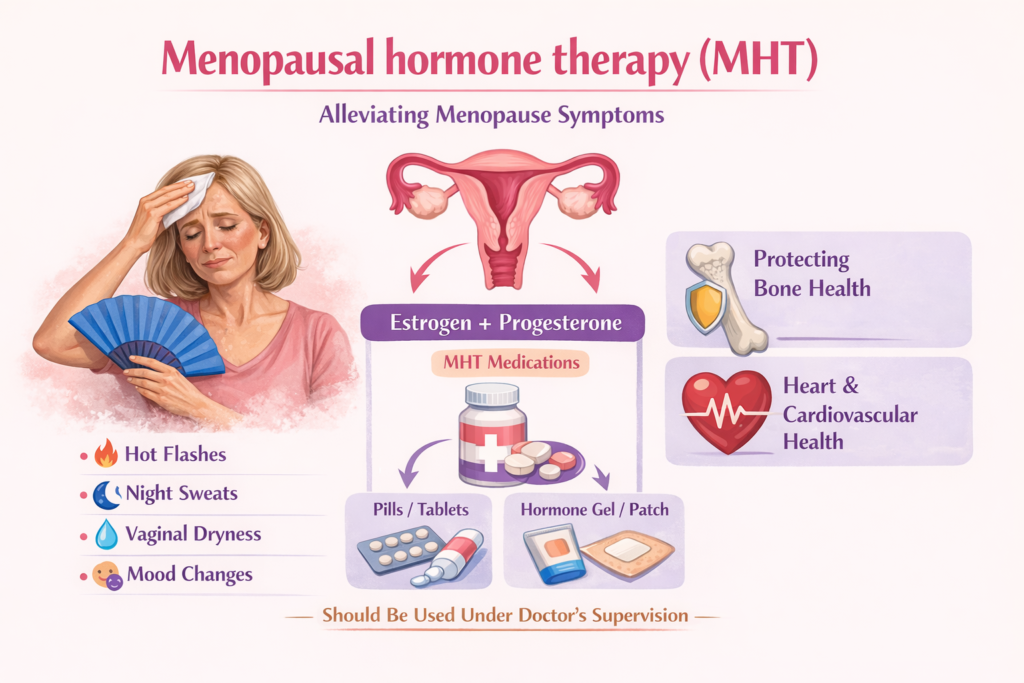
Menopausal Hormone Therapy (MHT)
Menopausal hormone therapy (MHT) is one of the most effective ways to reduce hot flashes, protect bone health, and improve quality of life during and after menopause. The key decisions involve how estrogen is taken, whether progesterone is needed, and how long treatment should continue.
Cardiovascular prevention is not an indication
MHT should not be started for primary or secondary cardiovascular prevention at any age.
Breast cancer risk depends on regimen and duration
- Estrogen‑only therapy (post‑hysterectomy) shows neutral or even slightly favorable breast cancer risk in long‑term follow‑up.
- Combined estrogen–progestogen therapy increases risk with longer duration.
Age itself is not the main determinant—duration and progestogen type matter more.
Estrogen can be given in three main ways:
- Oral estrogen works but passes through the liver first, which increases the risk of blood clots and stroke.
- Transdermal estrogen (patches, gels, sprays) goes directly into the bloodstream, avoids the liver, and has a lower clotting risk. It also provides steady hormone levels and reliably protects bones.
- Vaginal estrogen treats local symptoms like dryness or painful intercourse. It does not raise estrogen levels enough to protect bones. If this method is to be used for reasons such as vaginal dryness or urinary incontinence, it should be planned for long-term use, and treatment should not be interrupted intermittently. Its effect on atrophic vaginitis does not appear before 15 days.
To maintain bone strength after menopause, the body generally needs a certain minimum estrogen level, which transdermal therapy can achieve consistently. The lowest dose that improves vasomotor symptoms is not sufficient to protect bone health. However, unless there is a special situation, monitoring blood hormone levels is not necessary.
How long to continue therapy?
There is no longer a strict time limit such as the old “5‑year rule.” Treatment can continue as long as benefits outweigh risks, even after age 60 or 65. However, the current consensus is that treatment should be continued until the age of 60. After that, patient consent and a more detailed examination of risk factors are required. Bone loss returns quickly once estrogen is stopped, so long‑term therapy may be needed for bone protection.
Do estrogen receptors still work after menopause?
Yes. Estrogen receptors remain active throughout life, which is why estrogen therapy can still help bones even when started later.
What about progesterone?
Progesterone is required only for women who still have a uterus, to protect the uterine lining. After hysterectomy, it is not medically necessary. However, some women choose micronized progesterone because it may improve sleep, reduce anxiety, and stabilize mood.
Micronized progesterone is generally safer than synthetic progestins, which can affect multiple hormone receptors and may increase risks such as blood clots or breast cancer.
Overall:
Hormone therapy is not one‑size‑fits‑all. The best approach depends on a woman’s symptoms, health profile, and goals. Transdermal estrogen is typically the safest systemic option, vaginal estrogen is for local symptoms only, and progesterone is needed only if the uterus is present